

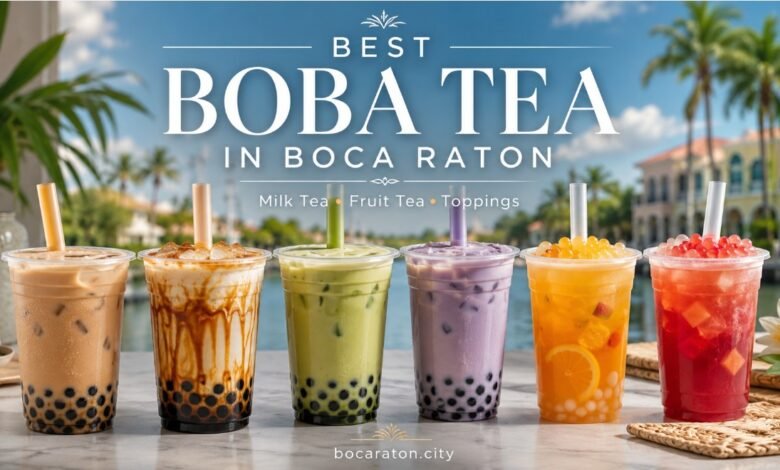
Looking for the best boba tea in Boca Raton? You have more choices than a simple “bubble tea near me” search may suggest. Boca has dedicated boba shops, national tea chains, independent cafés, Asian restaurants with full bubble-tea menus and options spread from East Boca and FAU-adjacent neighborhoods to West Boca.
The most useful way to choose is not by picking whichever pin happens to be closest. Some shops specialize in classic milk tea and tapioca pearls. Others are stronger for fruit teas, brown sugar drinks, matcha, slushes, cheese foam, fresh fruit, coffee or snacks. A place that is ideal for a first classic milk tea may not be the best choice for someone who wants a lighter passion-fruit tea with jelly or an ube drink with oat milk.
Current Boca Raton menus also show that a standard boba drink often lands roughly in the mid-$5 to mid-$7 range before extra toppings, depending on the shop and drink. That is a practical local reference rather than a citywide average: specialty lattes, multiple toppings, alternative milk and delivery-platform ordering can all push the total higher.
This guide focuses on actual Boca Raton options, what each area is useful for, how to read a modern bubble-tea menu, what toppings change the drink most, how sweetness and ice adjustments work, and what to order when you have never had boba before.
Where to start for bubble tea in Boca Raton
Boca Raton does not have one single boba district. The useful shops are scattered across several parts of the city, which means the best choice depends partly on where you already are.
Black Pearl Boba Tea
893 E Palmetto Park Rd, Boca Raton, FL 33432
A dedicated South Florida boba shop near downtown and the beach side of Boca. Black Pearl offers bubble tea, smoothies, juices, coffee and Asian snacks, making it one of the clearest East Boca destinations when boba itself is the reason for the trip.
Dedicated boba shop · East Boca
Boba Street Cafe
141 NW 20th St, Boca Raton, FL 33431
A strong choice near the FAU area with milk teas, fruit teas, slushes, specialty lattes, coffee drinks and snacks. The menu is broad enough for groups where one person wants classic milk tea and another wants something fruity or caffeine-forward.
Wide drink menu · FAU area
Kung Fu Tea
481 NE 20th St, Boca Raton, FL 33431
The Boca location of the national bubble-tea chain. This is a useful option for diners who already know the Kung Fu Tea menu or want a standardized selection of milk teas, fruit drinks, slushes and toppings.
National chain · Consistent menu
Tea Plus
21073 Powerline Rd #33, Boca Raton, FL 33433

A West Boca bubble-tea shop that also serves food, including ramen. It is particularly useful when the group wants both a drink and a substantial meal rather than a standalone dessert stop.
Boba + ramen · West Boca
Snow Bunny
1914 NE 5th Ave, Boca Raton, FL 33431
A local boba concept with milk teas, fresh tea drinks, smoothies and specialty flavors. Current Boca menus also show Snow Bunny drinks through Ramen Lab locations, including classic brown sugar, strawberry matcha, Thai tea, ube and fruit-focused options.
Local concept · Specialty drinks
Snow Bunny at Ramen Lab — West Boca
20449 State Road 7, Unit A-5, Boca Raton, FL 33498
Useful for West Boca residents who want a full meal and boba in the same order. Current menus include milk teas, signature drinks, fruit teas, slush-style drinks and add-on toppings.
West Boca · Boba with full meal
These options cover several different kinds of boba experience rather than six copies of the same shop. That matters more than simply ranking them from one to six.
East Boca: the strongest area if you want a dedicated boba stop
East Boca gives you several practical choices without driving far west.
Black Pearl Boba Tea is especially easy to understand as a destination because boba is central to the business rather than a small add-on to another restaurant menu. Its Boca location sits at 893 E Palmetto Park Road, close enough to downtown that it can fit naturally into an afternoon or evening around Mizner Park, Palmetto Park Road or the beach side of town.
The shop describes its lineup as a mix of boba flavors, fresh fruit smoothies, juices and imported coffee, with boba available as an add-on to crafted drinks. It also serves Asian snacks and casual foods such as steamed buns, dumplings, Korean-style corn dogs, ramen and desserts.
That gives Black Pearl a useful role: it works for someone who wants bubble tea but also for a group that wants something to eat without committing to a formal restaurant meal.
A little farther north, Snow Bunny provides another East Boca direction. The attraction there is not merely standard black milk tea. Current menus emphasize flavors such as ube, matcha, Thai tea, brown sugar, lychee, passion fruit and fruit-forward drinks.
This is the part of Boca where a boba trip can easily be paired with downtown errands, FAU, the beach or dinner elsewhere.
The FAU and NW 20th Street area gives you some of the easiest menu comparison
Around NW and NE 20th Street, Boba Street Cafe and Kung Fu Tea are close enough geographically that they serve similar local demand but offer different experiences.
Boba Street Cafe
Boba Street Cafe at 141 NW 20th Street has one of the easier current menus to examine before you leave home.
The selection includes classic milk tea styles, fruit teas, slushes, specialty lattes, iced coffee and other blended drinks.
Current examples include Brown Sugar Milk Tea, Taro Milk Tea, Thai Milk Tea, Mango Milk Tea, Strawberry Milk Tea, Lychee Fruit Tea, Pomegranate Fruit Tea, Watermelon Fruit Tea and specialty drinks such as Taro Lava Latte.
That breadth is useful when ordering for several people because “boba” does not have to mean everyone drinks the same heavy milk tea.
Kung Fu Tea
Kung Fu Tea at 481 NE 20th Street is the opposite kind of strength: it is part of an established national chain with a large menu system and app-based ordering.
For someone who has already visited Kung Fu Tea in another city, familiarity can be an advantage. You know roughly how the categories work, how toppings are ordered and what style of drink to expect.
It is also useful when a customer wants to explore beyond one signature item. Large chain menus generally give you several routes: tea-forward drinks, milk teas, fruit punches, slushes and topping-heavy dessert drinks.
Neither model is automatically better. Boba Street is attractive when you want an independent local café feel and current specialty combinations. Kung Fu Tea is useful when consistency and a familiar ordering system matter more.
West Boca has enough boba that you do not need to drive east every time
Residents west of I-95 or around Powerline Road, Glades Road and State Road 7 have increasingly practical options.
Tea Plus
Tea Plus is at 21073 Powerline Road #33 and identifies itself directly as a bubble-tea store. Its current site also emphasizes fruit teas and ramen, making it one of the more food-oriented boba stops in Boca.
That distinction matters when bubble tea is part of dinner rather than the whole outing.
A fruit tea can work beside a rich noodle soup much better than an extremely creamy drink for some diners, while milk tea can act almost like dessert after the meal.
Snow Bunny — West Boca
Snow Bunny drinks are also available through the West Boca Ramen Lab at 20449 State Road 7, Unit A-5.
Current menu examples are unusually helpful because they show actual pricing and customization.
Core milk teas are currently listed around $7, while several signature drinks are around $7.50. Available examples include Classic Brown Sugar Milk Tea, Strawberry Matcha Milk Tea, Tiramisu Milk Tea, Bunny Matcha Thai Tea Latte, Ube Milk Tea, Matcha Milk Tea, Tiger Brown Sugar Milk Tea and Thai Milk Tea.
Toppings such as black boba, fruit popping boba and jelly are currently shown at roughly $0.75 extra on that menu. Oat-milk substitution is listed separately as an additional charge.
This is exactly why a $7 menu price does not always mean a $7 final drink. Customization can move the total noticeably higher.
How much does boba cost in Boca Raton?
A useful local reference is roughly the mid-$5 to mid-$7 range for many standard drinks before multiple add-ons, but there is no honest single “Boca Raton average” based on the menus checked for this guide.
Boba Street Cafe currently provides several concrete examples.
Brown Sugar Milk Tea: about $6.25 on the current menu.
Taro Milk Tea: about $6.25.
Thai Milk Tea: about $6.25.
Lychee Fruit Tea: about $5.95.
Watermelon Fruit Tea: about $5.95.
Taro Lava Latte: about $6.75.
Specialty iced coffee: some current items reach about $7.
Snow Bunny’s current Boca ordering menus show another useful range: many milk teas and fruit teas around $7, with signature combinations around $7.50.
These numbers should be treated as menu snapshots, not permanent promises. Drink size, platform markup, toppings, alternative milk and future menu updates all affect what you actually pay.
Delivery can also distort the comparison. A drink that appears only slightly more expensive on an app can become substantially more expensive after service fees, delivery charges and tip.
A $6 drink can easily become an $8 or $9 order
The base drink is only the beginning when you customize heavily.
Suppose a menu lists a milk tea around $7 and one topping costs roughly $0.75. Add tapioca pearls and the drink is around $7.75 before tax. Add another topping and an alternative milk charge and you can quickly move above $9.
That does not mean toppings are overpriced or unnecessary. It simply means the best way to compare shops is to compare the drink you actually order rather than the cheapest number printed on the menu.
If you always order oat milk plus pearls plus jelly, your personal “boba price” is different from someone who orders plain jasmine fruit tea with no topping.
What should you order if you have never tried boba before?
A first drink should teach you what bubble tea is without burying you under five toppings and an extremely sweet specialty recipe.
Three starting points work particularly well.
Classic milk tea with tapioca pearls
This gives you the most recognizable experience: brewed tea, milk or creamer, sweetness and chewy black tapioca pearls.
Black tea or jasmine milk tea are useful first choices because the tea flavor is easier to identify than in a heavily flavored taro or dessert drink.
Brown sugar milk tea
Choose this if you already know you like sweet, creamy drinks.
Brown sugar syrup creates caramel-like depth and the pearls often become central to the drink rather than merely an optional topping.
Fruit tea with jelly
This is often the safest introduction for someone who does not want dairy or a heavy drink.
Passion fruit, mango, lychee or peach tea paired with lychee jelly or another fruit jelly is refreshing and easy to understand.
The important mistake to avoid is assuming that the first boba drink must be the biggest, sweetest item on the menu.
Milk tea is a category, not one flavor
When a menu says milk tea, the tea base can still vary.
Black tea creates a deeper and more robust drink. Jasmine tea gives a more floral aroma. Oolong can introduce roasted or floral notes depending on the style. Thai tea tends to be much more distinctive in color, spice and sweetness.
Then flavors are layered on top.
Taro produces a creamy, mildly nutty-sweet profile. Mango milk tea pushes the drink toward fruit. Strawberry milk tea is sweeter and more dessert-like. Matcha is earthy and slightly bitter beneath the milk and sugar.
The tea base matters most in simpler drinks. Once the cup contains strong syrup, cream mousse and multiple toppings, subtle tea differences become harder to notice.
Fruit tea is usually the better Boca Raton choice on a hot afternoon
South Florida weather makes fruit tea especially practical.
A cold passion-fruit, lychee, mango, peach or citrus tea can feel far lighter than a large milk tea when you are walking outside in August.
Fruit teas also pair naturally with jellies and popping boba.
The topping changes the experience without necessarily making the drink creamy.
Boba Street currently lists several fruit-tea flavors, while Snow Bunny menus include peach, strawberry, mango, lychee and passion-fruit tea options.
If you dislike very sweet drinks, fruit tea is also often easier to customize down because the tea and fruit can still provide flavor after sugar is reduced.
Brown sugar boba is closer to dessert than plain brewed tea
Brown sugar drinks are popular for a reason: warm caramel and molasses-like flavors work extremely well with chewy tapioca pearls and cold milk.
But they should not be used as the standard for judging every boba shop.
Some versions contain relatively little actual tea. Others use milk tea as the base. The brown sugar syrup can also dominate the cup.
If the drink is photographed with dark syrup streaks around the inside of the cup, expect a richer and sweeter experience than plain jasmine milk tea.
For someone who usually orders frappes, milkshakes or sweet iced coffee, brown sugar boba is often a very easy transition into bubble tea.
Matcha boba can be excellent, but sweetness decides whether you taste the tea
Matcha naturally carries vegetal bitterness and umami.
Milk softens that intensity, while sugar makes it more approachable.
Too much syrup can turn matcha into little more than a green-colored sweet drink. Too little sweetness can be challenging for someone new to matcha.
A medium sweetness level is a useful starting point when the shop allows adjustment.
Strawberry matcha is another approachable route because fruit sweetness creates contrast with the earthy tea. Snow Bunny currently lists a Strawberry Matcha Milk Tea among its specialty drinks.
Taro, ube and purple drinks are not all the same
Purple is a color, not a flavor category.
Taro and ube are different ingredients, and menus sometimes combine their names in ways that confuse first-time customers.
Taro drinks are generally mild, creamy and softly nutty or vanilla-like depending on the preparation.
Ube is a purple yam and can taste richer and more distinctly sweet-potato-like, with dessert associations.
A shop may use powders, purees, syrups or house-made preparations, so two “taro milk teas” can taste dramatically different.
If the ingredient matters to you, ask whether the drink uses actual taro or ube, a prepared powder or a flavored mix.
Tapioca pearls are only one boba topping
In everyday American usage, people often use “boba” to mean both the drink category and the black tapioca pearls.
Modern shops offer many more textures.
Black tapioca pearls: chewy, dense and usually lightly sweet.
Popping boba: thin shells that burst with fruit-flavored liquid.
Lychee jelly: firm, slippery and fruity.
Other fruit jellies: similar chew with mango, coconut or other flavors.
Pudding: soft and custard-like.
Cheese foam: creamy, slightly salty topping rather than something you chew.
Sago: much smaller pearls with a softer texture than standard tapioca boba.
The best topping depends on the base drink.
Traditional tapioca works naturally with milk tea and brown sugar. Fruit jelly is often better with fruit tea. Cheese foam can work with tea-forward drinks where the salty cream contrasts with bitterness.
One topping is usually enough for a first drink
Multiple toppings sound exciting but can make the cup difficult to evaluate.
Black pearls plus popping boba plus jelly plus pudding creates several competing textures and also displaces a meaningful amount of actual tea.
Start with one.
If you choose milk tea, begin with black tapioca. If you choose fruit tea, try jelly or popping boba.
Once you understand each topping individually, combinations become more useful.
50% sweetness does not mean the same thing at every Boca boba shop
Sweetness scales are relative to each recipe.
A 50% brown-sugar drink can still taste sweeter than a 100% unsweetened-style jasmine tea recipe because the underlying ingredients are different.
Some components may also arrive pre-sweetened. Fruit syrup, flavored powder, brown sugar pearls or canned ingredients can contribute sweetness even after the shop reduces added sugar.
For most newcomers, 50% to 75% sweetness is a useful experiment when customization is available.
People who regularly drink unsweetened tea may prefer less.
For an elaborate signature drink, however, the shop may not allow every sweetness adjustment because the recipe depends on a fixed sauce or mix.
Less ice changes both temperature and concentration
Ordering light ice sounds like a simple way to get “more drink,” but the effect depends on how the shop portions its recipes.
Some shops compensate with more tea. Others maintain a fixed liquid amount and simply leave more space. Some charge for no ice because extra liquid is required to fill the cup.
Current Snow Bunny ordering options, for example, show separate charges for light ice and no ice on at least some drinks.
That is a useful reminder not to assume customization works identically everywhere.
If texture is important, also remember that tapioca pearls change over time. A cup sitting for an hour in the car is not the same drink that left the shop.
Dairy-free boba requires more than asking for oat milk
Replacing regular milk is only one part of the ingredient check.
A milk-tea powder or creamer can already contain dairy. Cheese foam obviously requires separate attention. Pudding may contain milk or egg. Some specialty toppings and premixed bases can also complicate the order.
If you are avoiding dairy for preference, an oat-milk substitution may be enough for your needs.
If you have a milk allergy, ask about the entire drink recipe and cross-contact rather than assuming the words “oat milk” make the completed beverage dairy-free.
Fruit tea is often a simpler starting category, but even then specific toppings should be checked when allergies matter.
Is bubble tea vegan?
Some bubble tea can be vegan, but the category itself is not automatically vegan.
Tea, fruit syrup and tapioca pearls may fit a plant-based diet depending on ingredients. Milk, condensed milk, dairy creamer, cheese foam and certain puddings do not.
Alternative milk solves only the obvious milk component.
Ask the shop whether the base, powder, topping and foam contain dairy or other animal-derived ingredients when strict vegan preparation matters.
How much caffeine is in boba?
There is no single caffeine number for “bubble tea.”
A black-tea milk tea, green tea, jasmine tea, oolong tea, matcha drink and fruit-flavored drink can all have very different caffeine levels.
Coffee-boba drinks add another layer entirely.
Drink size and brewing strength also matter.
If caffeine is important because you are ordering late at night, ask what the actual tea base is rather than assuming milk tea is weak simply because it tastes creamy.
A fruit drink may still use a caffeinated tea base, while a smoothie or certain non-tea drinks may contain little or no tea caffeine.
Children and first-time boba drinkers should pay attention to pearl size and texture
Tapioca pearls are chewy and require deliberate chewing rather than swallowing quickly with the drink.
For younger children, a drink without large chewy toppings may be a more comfortable choice.
Jellies and popping boba also create their own textures and should not be treated like ordinary juice.
A simple fruit tea or milk drink without toppings lets a child experience the flavor without making the cup unnecessarily complicated.
Which Boca boba shop is best for classic milk tea?
Kung Fu Tea is a logical choice when you want a recognizable chain-style milk-tea experience and a wide standardized selection.
Boba Street Cafe is appealing if you want classic options alongside more independent specialty drinks.
Black Pearl is useful when you want a dedicated local boba shop rather than a tea menu inside a larger restaurant.
The best cup still depends on what you personally mean by classic: stronger black tea, creamier milk, softer pearls or less sugar can change the winner.
Which Boca shop is best for fruit tea?
Boba Street Cafe and Snow Bunny both currently show a useful variety of fruit-forward drinks.
At Boba Street, current examples include lychee, strawberry, watermelon, pomegranate and other fruit teas.
Snow Bunny currently lists peach, strawberry, mango, strawberry-peach, lychee and passion-fruit tea options on Boca ordering menus.
For a hot afternoon, these lighter drinks often make more sense than a thick milk tea or slush.
Which Boca option works best if your group also wants food?
Tea Plus and the Snow Bunny menus connected with Ramen Lab are obvious choices when food is part of the plan.
Tea Plus explicitly combines bubble tea with ramen.
Ramen Lab locations let you order a substantial meal and then add Snow Bunny boba drinks through the same ordering system.
Black Pearl also offers Asian snacks and casual foods, which can be enough if the goal is steamed buns, dumplings, Korean-style corn dogs or dessert rather than a full dinner.
Boba Street Cafe lists snacks and desserts alongside drinks as well.
What food actually pairs well with bubble tea?
The answer depends on the drink.
A sweet brown-sugar milk tea can function like dessert, so pairing it with another very sweet waffle or pastry may be excessive for some people.
A lightly sweet fruit tea works beautifully with salty fried snacks because acidity and fruit cut through the oil.
Plain or lightly sweet milk tea can pair with dumplings, buns or ramen without competing too aggressively.
Matcha drinks often work well after food rather than beside very spicy dishes because the subtle bitterness can disappear against heavy seasoning.
When ordering a full meal, consider the drink as part of the flavor balance rather than an automatic side beverage.
Bubble tea is Taiwanese in origin, but today’s Boca menus are intentionally global
Modern bubble tea developed in Taiwan and spread internationally, but the menus people see in South Florida now draw from many flavor traditions.
Thai tea, matcha, ube, Korean-style desserts, tropical fruits, coffee, cheese foam and American dessert flavors can all appear beside traditional tea-and-tapioca combinations.
That variety is one reason the phrase “boba shop” now describes much more than one Taiwanese milk tea recipe.
If you want to go deeper into drink styles, toppings, terminology and ordering beyond Boca Raton, this independent bubble tea guide is a useful broader reference.
Bubble tea, boba tea and pearl milk tea: are they different?
In everyday U.S. usage, bubble tea and boba tea are often used interchangeably.
“Boba” can refer specifically to tapioca pearls, but it also functions as shorthand for the whole drink category.
Pearl milk tea is narrower because it suggests milk tea with chewy tapioca pearls rather than fruit tea, slush or another modern boba-shop drink.
So a Boca shop advertising “boba” can legitimately sell drinks that contain no tapioca pearls at all.
You choose the topping rather than assuming every cup automatically contains black pearls.
What makes good tapioca pearls?
Texture matters more than appearance.
Good pearls should be chewy without feeling hard in the center or dissolving into paste.
They should also have enough sweetness to taste pleasant when eaten between sips without overwhelming the tea.
Freshness matters because cooked tapioca does not maintain perfect texture indefinitely.
That is why a busy shop with frequent pearl turnover can have an advantage over a location where a batch sits for a long time.
If pearls are the main reason you buy boba, evaluate the topping independently from the drink base.
What makes a good milk tea?
A good milk tea should still taste like tea.
Creaminess and sweetness can soften bitterness, but they should not reduce the cup to flavored sugar water unless that dessert-style result is intentional.
Take one sip before chewing the pearls.
Can you identify tea aroma? Does sweetness hit immediately and then disappear, or does it dominate every sip? Does the milk taste integrated or powdery?
Those details separate a balanced milk tea from a cup that relies entirely on toppings.
How to compare two Boca boba shops fairly
Ordering completely different drinks tells you which menu item you prefer, not necessarily which shop prepares tea better.
For a useful comparison, order something similar at both places.
Classic black milk tea with tapioca pearls is one good benchmark.
Keep sweetness approximately similar and avoid adding extra toppings.
Then compare tea strength, milk balance, pearl texture and overall sweetness.
After that, explore each shop’s signature drinks. A specialty strawberry-matcha drink should be judged as creativity, not as a direct test against plain black milk tea somewhere else.
Boba is good takeout, but tapioca has a clock
Most bubble tea travels easily because it is sealed in a cup and served cold.
The weakness is the tapioca.
Pearls continue changing in texture after preparation, especially as temperature changes.
If you are driving twenty or thirty minutes, the drink will usually survive far better than fries, but it may not be identical to a cup consumed immediately.
Fruit jelly and popping boba are generally less sensitive to the same short-term texture changes.
If delivery will take a long time, consider a topping that travels better or order directly for pickup.
Pickup can be much better value than delivery for one drink
Bubble tea is relatively inexpensive compared with a full restaurant entrée, which makes delivery fees feel disproportionately large.
A $6 or $7 drink can become a noticeably more expensive purchase after service fees, delivery charges and tip.
For several drinks, delivery may make more sense because the fees are spread across the order.
For one cup, pickup is often the financially cleaner option when the shop is already on your route.
Where should FAU students start?
The NW and NE 20th Street area is particularly convenient because Boba Street Cafe and Kung Fu Tea are both nearby options.
That makes it easy to choose based on the menu rather than driving across town.
Students who want a straightforward chain order may prefer Kung Fu Tea. Someone looking for an independent café menu with current drinks such as lava lattes, fruit teas, iced coffee and yogurt-style drinks may find Boba Street more interesting.
Price also matters when boba becomes a frequent habit rather than an occasional treat. One topping every time may not sound expensive, but repeated add-ons become noticeable over a month.
Where should downtown Boca visitors start?
Black Pearl at 893 E Palmetto Park Road is one of the most straightforward downtown-area boba destinations.
It works especially well if you are already around Palmetto Park Road, Mizner Park or heading east toward the beach.
Because the shop also carries snacks and other drinks, it works for mixed groups where not everyone wants milk tea.
Snow Bunny and the East Boca Ramen Lab drink menu give additional choices when you want specialty flavors or food with the order.
Where should West Boca residents start?
Tea Plus on Powerline Road is the most obvious dedicated bubble-tea stop in that part of the city.
Snow Bunny through the West Boca Ramen Lab at 20449 State Road 7 provides another substantial menu, especially if you also want ramen or another meal.
That means there is no practical reason for many West Boca residents to drive all the way to East Palmetto Park Road just for a standard milk tea.
Driving east makes more sense when you want a specific shop or signature drink rather than simply the nearest decent boba.
What if you want boba outside Boca Raton?
Nearby Deerfield Beach, Delray Beach and Boynton Beach can expand the search if you are already traveling in those directions.
But Boca itself has enough variety that crossing city lines should usually be about a specific shop or style, not because the city lacks bubble tea.
For a local guide, that distinction matters. The best “near me” result should first solve the problem close to home.
Do not rank a boba shop only by how photogenic the drink looks
Striped brown-sugar cups, bright purple ube, layered matcha and colorful popping boba are designed to look good.
That does not tell you whether the tea is well brewed or the tapioca is fresh.
Visual presentation is part of the experience, but taste still depends on balance.
A plain-looking jasmine milk tea with excellent tea aroma and chewy pearls can be a better drink than a spectacular layered cup that tastes mostly of syrup.
The best Boca boba order depends on what you already like
If you like iced coffee: try brown sugar milk tea, Thai milk tea or a coffee-boba drink.
If you like smoothies: try mango, taro, strawberry or another blended drink with pearls.
If you like unsweetened tea: choose jasmine, oolong or green tea with reduced sugar and one light topping.
If you like lemonade: try passion fruit, lychee, citrus or another fruit tea.
If you like dessert drinks: choose brown sugar, taro, ube, cream mousse or specialty latte styles.
If you dislike chewy tapioca: order jelly, popping boba or no topping at all.
There is no rule that a real bubble-tea order must contain black tapioca pearls.
A simple three-drink Boca boba tasting
If two or three people are trying bubble tea together, ordering different categories is more useful than buying three versions of the same drink.
- Classic milk tea with black tapioca. This establishes the traditional chewy milk-tea experience.
- Passion-fruit or lychee tea with jelly. This demonstrates the lighter fruit-tea side of the menu.
- Brown sugar, matcha or ube specialty drink. This shows how modern boba shops move into dessert territory.
Share tastes before deciding which category you actually prefer.
How often do Boca boba menus change?
Core items such as milk tea, Thai tea, taro and fruit teas can remain stable for long periods.
Specialty drinks change more often.
Seasonal matcha combinations, holiday drinks, new fruit flavors and promotional toppings can appear and disappear.
Inventory also matters. A menu page can still display a slush or topping while marking it temporarily out of stock.
If one specific drink is the entire reason for your trip, check the current ordering page before leaving.
Best boba in Boca Raton by situation
For a dedicated East Boca boba stop:
Black Pearl Boba Tea
893 E Palmetto Park Rd, Boca Raton, FL 33432
For variety near FAU:
Boba Street Cafe
141 NW 20th St, Boca Raton, FL 33431
For a familiar national chain:
Kung Fu Tea
481 NE 20th St, Boca Raton, FL 33431
For boba plus ramen in West Boca:
Tea Plus
21073 Powerline Rd #33, Boca Raton, FL 33433
For specialty drinks and local flavors:
Snow Bunny
1914 NE 5th Ave, Boca Raton, FL 33431
For West Boca dinner plus Snow Bunny boba:
Ramen Lab / Snow Bunny
20449 State Road 7, Unit A-5, Boca Raton, FL 33498
Boca Raton has enough boba variety that the “best” shop depends on the drink you want
Black Pearl is a natural East Boca destination. Boba Street and Kung Fu Tea make the FAU area particularly convenient. Tea Plus gives West Boca a dedicated bubble-tea-and-food option, while Snow Bunny adds local specialty drinks in more than one Boca setting.
For a first order, keep it simple: one tea base, one topping and moderate sweetness. Classic milk tea with tapioca teaches you the traditional format; fruit tea with jelly shows the lighter side; brown sugar, matcha, taro and ube demonstrate how far modern boba menus have expanded.
Price matters, but compare the finished cup rather than only the base menu number. Extra toppings, oat milk, no-ice adjustments and delivery fees can change a $6–$7 drink substantially.
Most importantly, choose according to what you actually enjoy. A strong fruit tea without pearls is just as valid a boba-shop order as a heavily loaded brown-sugar milk tea. Boca Raton has enough choices to make both easy to find.
